


Abdirizak Abdi’s Refugee Story
Abdirizak Abdi fled the civil war in his home country of Somalia back in 1991 and for nearly a year lived in Kenya before being resettled in New Zealand. Now, 18 years later, he has spent 11 years working with the Ministry of Education, affecting the lives of countless refugee and migrant learners, and for the past three years he has, on his own time, edited and produced the annual Somali Graduate Journal, an annual publication recognising the educational accomplishments of members of the Somali community. 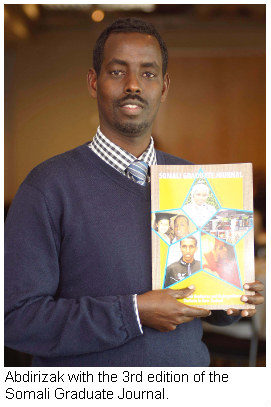
When Abdirizak arrived in New Zealand in 1993, he was part of the first group of Somali refugees brought here under the quota programme. Soon after he was resettled into the Hamilton area, he enrolled in university, ultimately earning a Bachelor of Social Science with a double major in economics and geography and later gaining Masters in Management Studies. Since then he has worked for the Hamilton City Council as Ethnic Communities Coordinator and as a cross cultural worker for Refugee Services. In 2000 he joined the Ministry of Education as the Central North Region’s Refugee Education Coordinator, and six years later he took up his current role as the National Migrant and Refugee Education Coordinator.
“I think education is one of the most important aspects of resettlement for former refugees,” he says. “So many other things, employment, health, they all start with education…. With my role and the regional coordinator roles, the Ministry is recognising the importance of education for refugees and migrants and showing support for them. My position allows me to support not just my community, but all refugee background and migrant communities in New Zealand in their education.”
Beyond his work with the Ministry, Abdirizak has also for many years served as a leader of the Somali community. In 2008 he created and produced the first the Somali Graduate Journal, an annual publication that profiles Somali graduates and undergraduates in New Zealand. “There had been some negative media attention at the time, and I wanted to show the positive side of the Somali community,” says Abdirizak. “As someone who has been here a long time, I have seen a lot of good things and a lot of successes. I thought, ‘Well, if the media isn’t going to write about all the good things, maybe we should do it ourselves.’”
The reception of the first issue of the journal far exceeded Abdirizak’s expectations, gaining attention from the Governor General, ministers and others around the country and the world. Equally as important was the recognition it received from other Somali communities around New Zealand. “Even though that first one was about graduates from the Waikato, it was as if it was about all the communities,” says Abdirizak. “Members of Auckland’s Somali community came to the launch and celebrated it just as much as those in Hamilton.”
The next year, Abdirizak gathered profiles of Somali graduates from all around the country for a nation-wide edition, and in June of 2011, the third issue of the journal was launched at the National Refugee Resettlement Forum at Te Papa Tongarewa. Since the journal’s creation, its impact has spread beyond New Zealand with copies even making it to the Annual Tripartite Consultation on Resettlement in Geneva. “I get emails from people who have been inspired by the journal,” says Abdirizak. “The impact has been so big.”
“The journal encourages the community to embrace education and to look forward and dream big for their future,” says Abdirizak. “These are the sort of stories that all communities can take inspiration from. I myself get so much inspiration out of it. The profiles are almost entirely the graduates writing their stories in their own words, the dreams they have, the challenges they’ve faced. They show that we should never underestimate anyone, including former refugees. That’s one of the things we communicate to schools through the Ministry of Education,” he adds. “Just because this may be the first time that a refugee background child has ever held a pen, that’s no reason to think they can’t achieve.”
Looking to the future, Abdirizak hopes to continue inspiring former refugees all over the world and encouraging policymakers to focus on education as a primary tool for successful refugee resettlement. “Empowerment is the key to helping former refugees build new lives,” he says, “and education is a way of empowering. Some of the graduates in the journal have dreams of changing the world, and I look at their backgrounds and what they’ve been through, and it’s great to see them dream so big. I believe if people are given the right support at the right time, if we focus on what is possible and not what is impossible, people can do anything.”
Abdirizak himself is a perfect example of what can be accomplished with the right support, and he hopes to see others go even farther. “Coming to New Zealand was the chance to regain my future, not to grieve what I lost,” he says. “I hope to instil that attitude in others as well. I want to say to them, ‘You’re here; you’re safe now. Don’t let go of your dreams. Bring them back to the surface. You can achieve them.’”
To read or download the latest Somali Graduate Journal or journals from 2008 and 2009, please visit www.somaligraduatejournal.org.